Showing posts with label imagination. Show all posts

Thursday, September 27, 2012

Beauty won't save the world alone

The title of Gregory Wolfe’s excellent collection of essays, Beauty Will Save the World, is based on a much-quoted line from Dostoevsky’s The Idiot. In its context it appears only in indirect speech, being attributed by one of the other characters to the “Idiot” of the title, Prince Myshkin. Thus in its original context its meaning is ambiguous, or at least ill-defined. That makes it doubly appropriate for Greg’s title, since he is arguing against the “ideologues” of today’s culture wars in favour of a literary and imaginative approach to the truth. Conservatives have succumbed to philistinism, and fail to appreciate modern art, he argues. Great literature, and art in general, explores the world – and today that means the modern world – from
the inside. It is not preachy or moralistic; as a result, conservatives of a Puritan or pragmatic bent often find it unedifying, or even profane. But it is legitimate, Greg believes, for art to shock, to revolt against established conventions, to make explicit what others may hesitate to look upon. In many cases this may the only way for the artist to discover a “redemptive path toward order”.

A particular target of the book seems to be those conservatives who can see nothing good coming out of modernity except the Inklings. I suspect Greg numbers me among them, although in reality my tastes are much broader than the things I tend to write about. But it is the case that my interest is less in literature and the arts, important though these are in posing the right questions and exploring the ambiguities of our time, than in philosophy and theology, where we legitimately search for answers to those very questions. This is not the same as seeking an ideology, though of course a theology can be rendered ideological easily enough. Theology at its most authentic is not a fortress of ideas, but more like a path across a landscape, a route map, or a system of signposts. It is intrinsically mystical, it is of the spirit not the letter.

Greg has developed a strong aversion to the kind of conservatism that rejects the modern world and gives up on modern culture, pretending to saw off the branch on which it sits. The importance of “Beauty” is that she is the only one of the ancient “transcendentals” that still speaks to us through modern culture. She is our way back to the vision of the whole, to a meaningful universe. But she has become separated from her sisters, Truth and Goodness, and thus relativized and subjectivized. Lacking a sense of transcendent Truth and Goodness, our culture is easily dominated by purely political and economic forces – power and money are the new transcendentals. He has a good account of how this happened, beginning with the Nominalists. But through it all, Beauty remains eloquent, calling us back to an awareness of Being and therefore of the reality our ideologies have squeezed out of the picture. The artist is the one who keeps us hearing this call to meaning, which is the breath of life.

The artist awakens the question of meaning, and takes us to the threshold of understanding. He speaks to the imagination, which is far more important than the rationalist in us admits. Imagination is our faculty for comparing and connecting the various parts of the world to make some kind of whole, a narrative in which we have a part to play, or an icon of the self we have lost. The imagination, Greg says, “works through empathy”. It is by empathy that the artist passes over from his or her own experience to that of another, and through that transcendence of self attains a glimpse of common or universal humanity beyond the reach of solipsistic individualism.

This is all very well, but will Beauty, will the imagination, “save the world” on its own? I doubt it very much. Beauty may prepare the world to be saved; it may crack the walls of our prison. But to pass through that crack we need something more. To step out of the cave and into the light we need the will to do so, and that can only be engaged if Beauty is reconnected with Truth and Goodness. Greg himself sees this. He is more than familiar with Balthasar's warning of the consequences of separating Beauty from her "two sisters", and he writes of artistic creativity as a "call" or "invitation" to virtue. It is a point that is hard to develop further without falling into moralism. The arts and literature are preparatory, even essential in some ways, to the life of the spirit, but nevertheless some more radical engagement with the world is necessary, and that is found in spirituality, in the inner life, in mysticism, in metaphysical intuition. That is not to say we must all become "intellectuals", because that word now refers to a kind of book-learning and cleverness that is very far from what I have in mind. We must become more open to a light that we only half remember, which comes from a horizon beyond the achievements of human culture however noble, and which answers the cries of the human spirit to which the artist gives a voice.*

I see this as one possible meaning of another work by Dostoevsky, The Dream of a Ridiculous Man. In this short story, a man intending to commit suicide dreams of an unfallen world of human beings living in peace with each other, with nature, and with God. But he also dreams of how he introduces sin and corruption into this world, until it becomes as bad as his own world, so that in a desperate desire to atone and heal he teaches them to make a cross and implores them to crucify him.

Awake again, his love of life is restored. “For I have seen the truth,” he writes; “I have seen and I know that people can be beautiful and happy without losing the power of living on earth. I will not and cannot believe that evil is the normal condition of mankind. And it is just this faith of mine that they laugh at. But how can I help believing it? I have seen the truth – it is not as though I had invented it with my mind, I have seen it, seen it, and the living image of it has filled my soul for ever.”

Here we see the role of the imagination, of the arts, which is ultimately to show us an image that our soul will recognize as true. But then we must act, we must become apostles, we must become “ridiculous”.
“The chief thing is to love others like yourself, that's the chief thing, and that's everything; nothing else is wanted – you will find out at once how to arrange it all. And yet it’s an old truth which has been told and retold a billion times – but it has not formed part of our lives! The consciousness of life is higher than life, the knowledge of the laws of happiness is higher than happiness – that is what one must contend against. And I shall. If only everyone wants it, it can be arranged at once.”

* This paragraph has been revised since first publication to express my meaning more clearly. – SC 

Thursday, July 26, 2012

The world on a bad day

The massacre at a cinema in Colorado where audiences were enjoying The Dark Knight Rises – the culmination of Christopher Nolan's Batman movie trilogy – seems to have provoked only a feeble discussion of gun control that is going nowhere, and very little on the showing of extreme violence in movies. The contrast with an earlier superhero film I have praised here – Marvel's Avengers – is very marked. I don't believe that the fact this massacre happened during the Dark Knight Rises rather than the latter is merely coincidental. Both deal with the battle of good and evil, but in very different ways. In fact two different kinds of imagination are
involved. In order to understand this we need to look at the relation of art to entertainment to pornography.

Art can deal with any kind of subject matter, but the way it does so matters. Great art deals with its subjects in a great manner. Commercial entertainment is both (usually) crasser in its methods and more limited in what it encompasses – essentially, subjects with mass appeal, in order to maximize profit, but with certain limits, pornography being one. But the boundary between them is hard to define, or rather hard to agree upon. The most successful entertainment is often a work of art, and of course both art and entertainment may contain elements or notes of pornography (art may even deal explicitly with pornography as a topic).

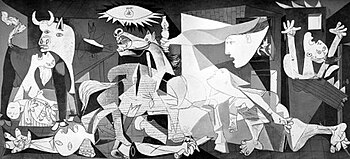
Guernica by Picasso is great art dealing with the topic of state-sponsored violence. We are meant not to like it, but be disturbed by it. The Hunger Games trilogy covers the same topic in the mode of "entertainment". But a pornographic photograph or movie depicts violence in a way designed to titillate the human organism into wanting more. In fact some neurophysiologists regard pornography as addictive, due to a release of chemicals in the brain. But there is more to this than physiology.

The human imagination mediates between the senses and the intellect, or the world and the spirit. It can therefore face in two very different directions – call them up and down. Facing "up" it is open to the light of the spirit, and reveals a world of forms shining through the images it constructs. An extreme example would be an icon or work of sacred art, which acts as a window towards the heavenly world that is more real, and more eternal, than the everyday. But any great work of art, I would argue, does this in a way. For example A Child Consecrated to Suffering by Paul Klee, which bears relatively little relation to naturalistic forms, may help to reveal a spiritual essence more effectively than a photograph or naturalistic painting, or a work by a lesser artist.


But what if the imagination faces "downwards"? In certain types of surreal art (though not all) and also in pornography, whether of violence or sex, images drawn from nature are blown out of proportion and arranged in such a way as to turn the soul away from the world of the spirit and introduce it to something baser, more corrupted, and more dangerous – also something less real than the world around us. The effects on us as consumers is rapidly apparent.

The Dark Knight series is not pornography, but its imagination is looking in several directions. It looks down into the pit of evil, it glances up to archetypes of heroism, and a lot of the time it looks around at a caricature of the world in between, in order to assure us that this is what it is really about: the world of the everyday, or rather the world on a bad day. Avengers has a different balance to it. The sense of violence and evil is less overpowering, because it is not intent on gazing into the abyss; it is less oppressive, because the movie is not trying to convince the cynics among us that it is about real life. (Compare Tom Hiddleston's Loki with Heath Ledger's acclaimed Joker, both great performances.) Avengers tries to look more in the direction of the archetypes, which inspire heroes. It does so lightly, with a generous seasoning of humour. And in so doing it lifts the spirit rather than casting it down.

Thursday, September 29, 2011

Second Spring Catechesis

Take a look inside, and help your child follow along with the new Missal translation!

Some years ago we started our own publishing with the idea of producing high-quality artwork in children's colouring books in service of an imaginative and symbolic approach to catechesis. That simply means that rather than talk to kids about religious ideas, we would show them. Our colouring books use the symbolic language of Nature and the Bible to introduce children to the mysteries of the Catholic faith. One of our books is written by Scott Hahn. The beauty and enjoyment of interacting with the illustrations means that the child enters more deeply into the symbolism and the "visual language" of faith - the same language we find in icons, illuminated manuscripts, stained glass windows, mosaics, and frescoes.

In developing this approach, Leonie Caldecott was partly inspired by Sophia Cavaletti. Leonie saw it as an application of the fundamental principle of the new evangelization: the intimate association of truth and goodness with beauty. This implies a vital role not only for intelligence and will but for imagination in religious formation. The Vatican has called for an “evangelization through beauty”, since this is the main way in which modern people can still relate to the Christian tradition and begin to grasp its meaning for them. But the first challenge was getting children to relate to the central act of worship, the Mass, which is why our lead title was always THE MASS ILLUSTRATED FOR CHILDREN, now issued in a revised edition, with improved illustrations and a text drawn from the new translation of the Roman Missal - so that the book can be used not only for colouring but as a first Missal, helpfully guiding the child through the unfamiliar prayers and responses of the Mass. (Order now, for delivery in October.)

Second Spring Catechesis involves taking the child, and the child’s sensibility and culture, much more seriously than most other forms of catechesis have done. It opens windows in the child’s imagination through which the vision of the faith can be transmitted, or (to vary the metaphor) it prepares the ground and plants the seeds for a later, more intellectual appreciation of the faith in the child’s mind. To nourish the child’s sense of mystery and of the sacred is essential for the healthy development of the life of faith and prayer through the difficult years of adolescence that lie ahead. The further benefit of exposing children at an early age to a wide range of rich and beautiful imagery lies in helping to perpetuate the best artistic traditions of Christianity. By fostering an appreciation of how icons function to express religious truths and support the interior life, Second Spring Catechesis thus complements and extends the work being done for an older age group by David Clayton in Thomas More College’s “Education in Beauty” program. Indeed David himself has illustrated two of our books for children, adapting his knowledge of traditional styles and techniques for the purpose. New titles are in preparation for next year, but in the meantime we hope you will order THE MASS for your parish or class, either through our UK distributor Prompt Reply, or if you live in N. America through our US distributor, Thomas More College, who can also give you current US prices.