eDigital assisted to the NSW Goverment Open Data Forum on Monday 11th November 2013.
Andrew Constance, Minister for Finance and Services presented the new NSW Open Data Policywhich helps facilitate the implementation of best practice open data principles across the NSW public sector.
Key note speakers included John MacMillan AO, Australian Information Commissioner, OAIC and Elizabeth Coombs, NSW Privacy Commissioner.
Interesting findings:
Apps 4 NSW: apps4nsw is the first State Government apps competition in Australia. The objective of the apps4nsw competition is to capture innovative ideas using public sector information and data that are useful to the people of NSW.
GovHack:Gov Hack Day in Sydney was held in May 2013 were hundreds of hackers joint together to form teams and work together to create best new mash ups, data visualisations and apps with Government data. It is expected for another Hack day to happen next year.
Australia Government spend 51 million dollars a year on a Contingency Strategy. 7 million australians with contingency issues. A public Toilet Map app was created.
GIPA Actestablishes an open approach to gaining access to government information in NSW. The objective is to have a Government that is open, accountable, fair and effective, by authorising and encouraging the proactive public release of government information by agencies; giving members of the public an enforceable right to access government information, and ensuring that access to government information is restricted only when there is an overriding public interest against disclosure. The guiding principle of the GIPA Act is the public interest, with a general presumption that disclosure of information is in the public interest, unless a strong case to the contrary can be demonstrated.
Shruti Shetty - Art Director & Data Science enthusiast
Mauricio: Why your passion for Design and Data Science?
Shruti: Design has gone through quite a silent transformation over the years. The canvas, the technology, the aesthetics have all evolved significantly. Now more so than ever I think, design plays a very central role in tying all these changing features and packaging them for experience. Moving into the new age of the Data Economy, made me look and explore this new and next avenue that will impact design in the coming few years. This lead me to Data Science.
M: Data Science brings insights from analysing data sets. Design can then help present those insights on ways they are easily understood but also engaging and interactive. As a result, those new insights or findings from data sets can highly resonate with audiences...is that correct?
S: That's correct. Traditionally data analysis and handling has taken place in the development or mathematical sense of the world. With the help of design, we translate those complex models, from texts and numbers to patterns, which we can see and understand, and in context to a collateral situation or problem. As said, an image might be as powerful as thousand words.
M : Analysis of data is just one part of a story; in some cases investigative journalism, historical context, current market, political, economic and social dynamics have also a great influence on helping shape data into powerful insights. How do you see the future of Data Science with other disciplines and how Design can play a key role?
S: Patterns are everywhere. They are the very fabric of human behaviour, which has now translated to our online lives. With the power of technology and our need to be switched-on 24/7, we are contributing continuously to this massive data pool. This also means data is being continuously altered and influenced by all and/or more factors, than the ones mentioned above. Hence, before we even begin processing the dataset, we try to understand the circumstances in which the data has been collected. Sometimes this can help fill in the blanks, with the bigger picture. The purpose of data science is to help tell our story, with the events & features of our data. As the scene setting changes so does the climax of the story. It can be quite hard to identify these influencers in the process of crunching numbers, and this is where visualisation comes into play, within the process itself. Visual tools also help determine the influencing features and charter an appropriate course for the story.We use tools like graphs, charts, plots etc. that display the workings of the data sets in a visual form. As mentioned before, design is a key interpretation of this story into a visuallanguage, which everyone can understand.
M: How important is for Designers (who help Data Scientists) to be involved from the early stages of data analysis? so they can fully understand final insights and create solutions that matches what Data Science want to convey...
S: Designing or visualizing isn't an end mean or a final output stage. Many designers would agree, that design and creation is a journey and a process by itself. Such as data, design goes through it's own transformations, gradually. Hence for a desired optimised solution, collaboration between the two fields, is key. The key is to compliment and co-relate.
M: Is it the role of Designers to just help Data Science better visualise data insights? or the Design role goes far beyond that?... Can Design also help companies better collect data or help companies to find better ways to engage people to contribute to data? or even more, can design engage audiences to analyse data sets?
S: I began the studying data science, my intention was to implement this within our service pool, for our clients. The data we collect can help impact the strategy with which we can constantly improve our products or technology, given the patterns that our users or consumers display. Which in turn, gives them a better experience. This evolution needs to be refuelled by new and more precise data, which can again be facilitated by design. In short, we use design to translate the given said data, and help grow and alter the data set, to maybe evolve into a new pattern. According to me, this agile approach would best suit this relationship, between data and design.
M: There might be plenty of data visualisation tools these days. What tools have you worked with and found them great to use?
S: Open source softwares such as R Project , and Python, provide a suite of visual tools to crunch and model the data, during the process. The output results can be visualised using a suite of other tools. There are a lot of javascript libraries out there, to help with this. For eg: My team has used, Raphael.js in the past, for a real-time RFID visualisation project. At the same time, there are many other public toolkits to help with this. The one I have found useful is the Tableautoolset.
The Method Case: The project uses digital practices and processes to blur the lines between photography, data visualization, textile design, and computer science.
M: Organisations with no access to Designers or Data Scientists have a big challenge when analysing and presenting insights from data? Any tips for them?
S: Ideally, gathering of that knowledge and datasets would be the first step, moving into this direction. Maintaining records and collecting them in a consistent and efficient manner. I guess with any given field, you need to have access to expertise on that subject matter. If you don't have those skill sets in-house, you would seek those services elsewhere. Traditionally, companies have been gathering the knowledge for the datasets, but haven't been able to implement it's full potential, back into their businesses. For businesses that want to explore this area, there are plenty of options out there. There are independent Data Science organisations who can then collaborate and partner with other agencies, to help make use of their data. But at the same time, companies like ours - Adrenalin Media, are upscaling their skill sets to include this as part of their services, even for Small / Medium sized companies to big scale corporations.
M: Do you favour tools that automate the discoveries of regularities in data? meaning less work for data crunching and possibly just more work for finding compelling ways to present those discovered regularities?
S: I have learnt the hard way, there is no easy formula to help clean up datasets. Again, softwares like R and Python are quite versatile and can handle this process quite well. Personally I like the Google Refine programme, as it has some really nifty features such as a log of all the changes you have made to the dataset, which helps reverse back any mistakes you might have made.
M: As cloud services become more popular and affordable, companies now have the opportunity to collect massive amount of data. However the reality is most of that data gets untapped and/or un-used? Apart from using Data Scientists to help companies find better ways to achieve their key objectives/goals by effective analysis and presentation of Data turned into insights; is there anything else companies should be using their data for?
S: My answer would be similar to the above.
M: There is a lot of talk about how to use big data on organisations and companies but what about individuals, citizens using data for everyday life activities or local community based activities? Any examples or insights on this front?
S: Definitely! Why should all the big companies have all the fun? Sites like vizify.com help visualize your personal data into a cluster of visual graphics, aggregating all your stories online, from LinkedIn, Facebook, Twitter etc. Companies and services alike, have realised the power of visualization and there are a lot of them out there empowering us to take charge of our own data footprints to chart and describe the journey, in a visual form. It also helps keep things fun and interesting for the users.
M: Powerful visualisation of data is key but what about user interaction with data. Any user data driven projects and at what point can interactivity be a nuance for users to fully engage with stories and insights?
S: Interaction is such a powerful engaging tool. Data science wouldn't exist without user interaction. It's the basis of the records that we use. At the same time, the benefits of our insights are then used to display that information for the user to 'interact' with, in terms of engaging with and modifying a visual art piece or using a said service or product. The User interaction is central to the validation of the predictions that we as Data Scientists make. And design can then present this case for the user to accept or reject. In either cases, that would be fed back into the cycle, for the whole process to flow again. It's such a powerful concept, if one thinks about it.
M: What are possibly the top three projects you believe have implemented great design for their data driven projects?
S: Design can be assessed aesthetically or functionally. A good design follows a balance of both. Amazon, Netflix are a few of the companies that continuously update their design based on the data and user patterns that they record. While they aren't aesthetically prominent, they are studied to be one of the most effective use of Information Architectures. Similarly, you see startups such as Triptease, Evr.st etc. who hire data scientists, terming them as 'Growth Hackers' to bust and crunch the numbers and deliver visually stunning outputs for their users. The recurring themes with all these projects is the agile collaborative way that the data and the design teams work together to keep their services and their presence fresh and valuable.
Triptease - For finding lust worthy destinations curated by users
Shruti has a design background and been working in the digital space for the past 8 years now. After graduating from BillyBlue College in Sydney, with a degree in Communication Design, over the years she has specialised in User Experience and Information Architecture. In her current role as Art Director at Adrenalin Media in Sydney, her team produce online solutions, ranging from websites, campaigns to integrating new technologies into their services for eg: RFID.
Infographic explaining Big Data, made by James West and published by New Scientist. It starts with the most fundamental concept which drives big data 3 Vs of Big Data and then moves on to talk about trends, features and challenges of Big Data.
NEXT
Need Design support for your data sets? Call eDigital on +61481 367 711
We recently wrote an article about how to Invite all your Facebook friends to a Facebook page. Some times you also might need to invite all your thousands Facebook friends to a Facebook event but do not have the time to tick all those boxes next to your friends names.
WHAT TO DO - TIP AND TRICK Follow the below steps and you will get it done in less than a minute. Viola! Cheers Mauricio @ eDigital.
Join the event with your personal Facebook account using Firefox browser.
On the event page, click on "Invite friends" box - A pop up window will appear.
Scroll down until the end of the "Search by Name" list.
Open Firefox Scratch pad by going to Tools menu, then Developers, then Scratchpad.
Wait around 10-20 seconds and all your friends names should be now ticked.
Hope it works for you. If not give me a buzz and happy to assist +61481367711. Mauricio
NEXT
Need to support promoting with your event via social media? Call Mauricio - Digital Marketing Specialist, SEO & Social Media Specialist on +61481 367 711
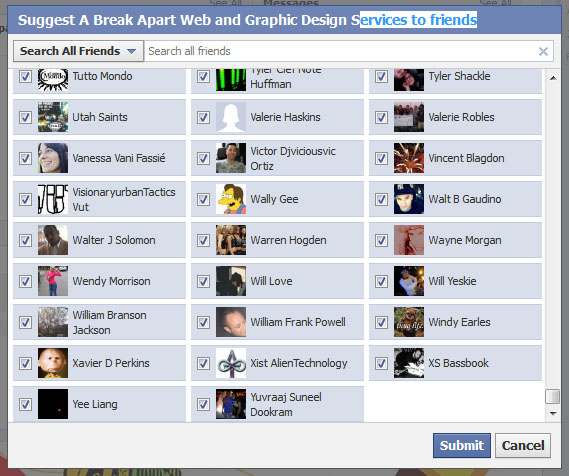
Recently we wrote an article on how to invite your Facebook friends to a Facebook event. However, sometimes you might also want to invite your thousands Facebook friends to "Like" a Facebook page but you do not have the time to manually select (tick) all those little boxes next to your friends names when inviting them to "Like" a Facebook page.
WHAT TO DO - TIP AND TRICK Follow the below steps and you will get it done in less than a minute. Viola! Cheers Mauricio @ eDigital.
Visit the desire Facebook page using your personal Facebook account (not as page admin logged in) using Chrome Browser. (Yes, this will only works using Chrome).
Click on "Invite friends" - A pop up window will appear.
Click on the arrow next to the box that reads "Recent Interations" and select: "Search all friends"
Scroll down until the end of the "All friends list".
Mac users using chrome to press "option + Command + J" - it will open the Chrome java script console.
Paste the below code into the console and then press enter.
var inputs = document.getElementsByTagName("input");
for (var i=0; i < inputs.length; i++) {
if (inputs[i].getAttribute('type') == 'checkbox') {
inputs[i].click();
}
}
Invite all your Facebook friends quickly by pasting a Java Script code into the Chrome Java Script Console - By eDigital
Wait for some 5-10 seconds and all your friends ( who have not been invited previously) will be automatically selected.
Hope it works for you. If not give me a buzz and happy to assist +61481367711. Mauricio
NEXT
Need to Support with your new Facebook page? Call Mauricio - Digital Marketing Specialist, SEO & Social Media Specialist on +61481 367 711
HOLA! I am back! writing my weekly article ( been busy with our successful launch of the new LEA Latinoamericanos Empresarios Australia business and entrepreneurs network last night in Sydney, Australia.
As promised last week, please find below all the fantastic learnings and tips I grabbed from the Pozible Crowdfunding Workshopon Tuesday 3rd September 2013 in Sydney. This crowd funding workshop was super valuable, specially now that eDigital has been engaged to help Vibrating Planet crowd funding campaign to be launched on the 27th of September 2013 at our Vibrating Planet launching party(All invited if you are in Sydney).
Pozible Crowdfunding Workshop September 2013 - Ambassador Suzie Nguyen speaking to the audience
KEY TAKEAWAYS FROM POZIBLE CROWDFUNDING WORKSHOP
Why people use crowdfunding
You can build an audience at low cost.
It allows to pre-sale your new products that are created as part of your project.
Unlimited potential to raise as much as your project can attracts.
It is fun! you will be very excited when successfully funding your project.
Tips for project and rewards participation
Involve people in your crowd funding project. The more they can participate and be part of it, the more they will be interested to support your project.
The above translates in creating "Intimate levels" of engagement that are unique to the project and rewards. Examples can be exclusive lunch/dinner rewards with project creators, donors to be part of the group that designs or selects the logo, supporters material (photos, stories) to be part of the project creative outcome, etc.
Quirkiness works - Be creative with your rewards structure. People love authenticity. It was mentioned a project where someone was raising to spend on a night out...then the the project raised $500 as the project rewards were so quirky and different.
Financial rewards are not allow in Pozible. You cannot give away money, shares, etc as part of a reward.
Top rewards can be companies that act as sponsors of that reward. Keep that in mind when negotiating sponsor opportunities. Sponsors like that as it gives them a level of certainty that they will invest to projects that are just successful.
Tips for funding target
Target the absolute minimum budget that is critical to get your project over the line, specially for first timers and project creators that might not have a strong or solid fan base.
You should budget for the creation, management and delivery of rewards as part of your funding.
Transparency is key! Supporters should be able to know exactly how you are going to invest/spend the raised money into the project. Provide exact details.
Tips for Marketing your project
Most of traffic comes from Project creators social media graph: Facebook and twitter accounting for the majority of traffic.
Contact every donor and say "Thank you" and remind them to invite their friends and family to donate.
Link from your project Youtube videos to your Pozible campaign via 'Annotation" feature on Youtube.
Once launched, you need to test your campaign and ensure payments are going through.
Decide on your voice and tone. Be consistent. Some might decide to NOT ask for donations. Instead, TheyINVITEpeople tobe partof their project; toparticipatewith in the project bycontributing via crowdfunding website and get a fantastic reward from project creators.
You need extra Collaborators: you need to find more people who can contribute to your project and hence talk about and promote your crowdfunding campaign!
We need to mapout key Influencers and reach them: People like to follow what influencers do! Is there any respected industry leader who could endorse your project? Can you ask other popular artist to donate and do a little story with them on why they supported you? You need to get endorsements from any popular industry leaders and promote their support to your project via social media.
Flyers needed! When you meet new people during your crowdfunding campaign, a flyer needs to be given to them so they can participate on your campaign. People do not necessarily remember web addresses. Give them an amazing flyer that they cannot resist following up when they get back home.
You need to map out our activities calendar! To keep people engaged via Social Media and as a way to remind them to donate, you need to plan and promote all your project daily activities during the the campaign period! You need to action this from the very beginning! Activities can be:
- Concerts and gigs you will offer.
- Collaborators you meet and start working with you.
- Confirmed places you will visit as part of your project and people who will be hosting you.
- Influencers you have met and endorse you project.
- Crowdfunding updates, money raised so far.
- Confirm sponsors
- Other collaborations and stories.
You need visuals! use photos and videos, and plenty of visual clues that our project is going to be successful!
Setting up your Crowdfunding campaign
Video describing the project is absolutely essential for improving the chances of success. Make it less than 3 minutes long.
Video and project description MUST be authentic, genuine, transparent and honest.
Tone of voice is extremely important. Ensure you get it right. seek for advice from professional communications specialist or watch other successful funded projects.
Check below Amanda Palmer - The art of asking video - very inspirational video.
NEXT
Need to Crowdfund but do not have the time to project manage it? Call Mauricio - Digital Marketing Specialist, SEO & Social Media Specialist on +61481 367 711
As global mobile app market is to triple in just less than 3 years time; I wanted to have a refresher tonight at Mobile Monday Sydney. Key takeaways to follow suit this week.
Bosses pretending to be leaders should watch this video!. Has your boss really earned the Leadership position? or is it just "Authority" what she/he actions. When people feel safe (have a circle of safety) they care about each other and collaborate. This caring, collaboration and work together exchanges create trust, innovation and success. The role of a true leader is to create this circle of safety and sacrifice anything to protect it. In the above video, Simon Sinek remind us how our four main chemicals that control all the feelings of happiness and joy, enable us to reward our activities to our best interests and how "true leaders" earned their position by activating the right "selfless" chemicals (no selfish ones); creating and defending their circle of safety around their teams. Below a quick summary of what Simon talks about each of the chemicals: SELFISH CHEMICALS Endorphins
Allow us to mask physical pain.
Give us the energy to achieve physical task with no pain.
Dopamine
Feeling we get when we accomplish a goal.
We get dopamine when we achieve what we set to achieve.
Dopamine make us focus to get to that goal.
Dopamine boost is generated when we reach that dream.
People love e-shopping because they get that feeling of finding what they were looking for.
Dopamine is highly addictive: Nicotine, alcohol, gambling, mobile phone.
Completion of Intense cravings for food release dopamine.
When people hit dollar based incentives at work they get dopamine releases.
SELFLESS CHEMICALS
Serotonin
Give us the feeling of pride and status
When you win something and get public recognition. We get serotonin.
It gives self-confidence.
Serotonin is attempting to reinforce behaviour that encourage co-operation, collaboration.
I will sacrifize and do good things for you so you can continue to do good things for people.
it can get short-circuited: likes on Instagram and Facebook. but it is artificial as we did not do anything for anybody.
Conspicous displays of status might offer serotonin but it is fake burst as we did not do anything for anyone to get it. The serotonin feeling eventually runs out.
Serotonin is the chemical of leadership. Alphas get first choice of meat and made (special treatment) but it does not come free. Leaders will have to be willing to protect their people in times of danger as they are fitter and better fed than anyone else.
Leaders are the ones who are willing to sacrifize themselfs to protect their people and do not break the social contract.
Oxytocin
That great feeling of love and trust.
Oxytocin is trying to get us to look after each other.
Physical contact produces oxytocin.
Business is about human relations and our willingness to trust someone we can trust our back and we are not going to get stab.
Acts of generosity releases oxytocin: spending time and energy with NO expectation on anything in return.
Givers, Recipients and witnesses of acts of generosity also can release oxytocin.
Oxytocin make us more generous. Make us nicer people.
and one last chemical Simon did not mention on this talk (but in others of his talks) that also help us...
Cortisol
The chemical of anxiety.
Help us be alert to imminent threat.
Make us hyper aware
Is your boss really building an environment where you feel safe so you can co-create, experiement and collaborate freely?
Would your boss really protect you and your team in case of imminent danger?
NEXT
Call Mauricio - Digital Marketing Specialist & on +61481 367 711
I also got in touch with Justin Urbanski who works as a Scrum Master using "Agile" Methodology for new product development. Justin kindly shares his view about Agile Methodology in Australia and its benefits below.
Mauricio: Why are you so passionate about "Agile" Methodology?
Justin: On the train ride to the 2009 Agile Australia conference in Sydney I was reading "Agile Estimation and Planning" by Mike Cohn. On the train ride back I was writing my speech to management on why we need to go Agile. The conference is not the sole reason I am so passionate. When I first started reading about Agile it just made sense to me. In a way it was sort of how I liked to work anyway.
Justin Urbanski - Scrum Master - Australia
M: What does "Agile Methodology" mean and what are its key benefits compared with other project development methodologies?
J: Agile is an umbrella of methodologies. A team should choose which methodology is right for them. Agile differs from the traditional Waterfall method in that it promotes iterative development and self organising teams. Instead of doing 6 month software releases, in Scrum (one of the methodologies) we have 2 week sprints. At the end of each sprint the product is potentially shippable. Everyone can then inspect where the product is at, how the market is going, what the customers want and adapt every sprint. That's the difference and one of the key benefits.
In Scrum cross functional teams work through tasks. The teams are also self organising. I used to be a project manager and assign tasks to individuals to ensure that the project completed on time. I don't have to do that anymore. The teams simply pick off the highest priority tasks and work on it within a sprint. The team members decide who works on what. It's hard to explain but because the teams are working in short sprints and they continually inspect and adapt and eventually they become high performing. The teams talk about how they can get better and better both technically and organisationally. Its not a manager telling individuals how to improve, its a team understanding how they can go faster. That's the benefit.
Agile Methodology Cycle
M: You are a Scrum Master. What are the benefits of having a scrum master in a project development team?
J: Yes I am a Scrum Master. A Scrum Master serves the team. The Scrum Master does everything he or she can to help the team and make them as productive as possible. Like a coach on a football team, the Scrum Master should observe the team and help them adapt.
Scrum Master Position within a Product Development team
M: Is there anything on "Agile Methodology' that we could use for digital marketing processes, ie: managing social media, improving Search campaigns, producing content, etc?
J: I don't see why not. You just need to determine which methodology would be best for your team. For example Kanban may be the way to go. It helps teams prioritise and limit work in progress.
In Scrum you have a Product Owner. Their responsibility is to control the budget and vision. So they set what things should be worked on first to achieve greater return on investment. I don't see why you could not do that in the digital marketing space.
Kanban Methodology simplified
M: For entrepreneurs, is there any risk of taking/using "Agile methodologies" in their product development processes?
J: No, and I believe it would be beneficial because you continually inspect and adapt. A great book to read is "Thelean startup" by Eric Ries.
M: What are your top two project development management tools you would suggest for teams to track Agile projects (Jira?, others)
J: I am very familiar with Jira and it works well. I would suggest the Atlassian suite which includes Greenhopper and Confluence. Because they are both Atlassian products they integrate easily. Greenhopper is the Agile part and helps teams organise and plan sprints. Confluence is Atlassian's wiki. I love it because it enables teams to collaborate and document quickly.
Jira Dashboard - Example
M: Is there any specific products/services or even industries that tend to be better fit for 'Agile methodologies" why?
J: Agile is targeted for the software industry and I believe suits the development of any software product. Web based products tend to be the best fit because when you inspect and adapt each sprint there is something to show. Plus web based products tend to be more volatile and also easier to release each sprint. M: What are Australian companies implementing best practises Agile metholodogies? J: In Australia there are too many companies to list who is doing best practise. The thing is that every company is different. If you have the right people and the right coaches then hopefully those people are getting the most out of their Agile journey. M: Is there anything Agile teams should avoid when using Agile Methodology? J: Firstly avoid ScrumBut. If you do not Scrum properly then you will not get the most out of your teams. Secondly be patient. Your Agile transition is a journey. It takes years to get it right.
M: Can someone use Agile methodology for everyday activities? how?
J: Yes there are people using it in schools and I have even used it at home. At home I setup a Kanban wall to help organise our family activities.
M: How we do compare with America on the adoption of Agile methodologies and what companies in Australian are taking the lead?
J: I don't know the stats or about America but Agile in Australia is thriving. In 2009 there was the first Agile Australia conference. We now have 5 or more Agile conferences per year in Australia. The leading companies are Thoughtwoks, SMS MT, Suncorp, and Atlassian just to name a few.
M: Where people can learn more about what you do? please send us your website, blog, twitter, etc.
J: The best way is to just contact me via email for any questions your readers may have.
M: Anything cool or funny that you have experienced by working with Agile teams?
J: The coolest thing is watching a Scrum team grow into a high performing one. That's what I love about Agile. Its about the soft skills just as much as the technical skills. The soft skills allow teams to build the rapport that enables them to produce remarkable software.
NEXT
If you are a Scrum Master or Agile expert who would like to contribute to this article please let me know. Mauricio. Call Mauricio - Digital Marketing Specialist & on +61481 367 711